
.svg)
Why the Rio Grande Valley Belongs in Clinical Research
Every September 15 through October 15, Hispanic Heritage Month gives us a reason to celebrate the culture, history, and families that make the Rio Grande Valley what it is. At Texas Valley Clinical Research, it also gives us a reason to talk about something we think about every day: who gets included when new medicines are tested, and who gets left out.
The Gap Nobody Should Accept
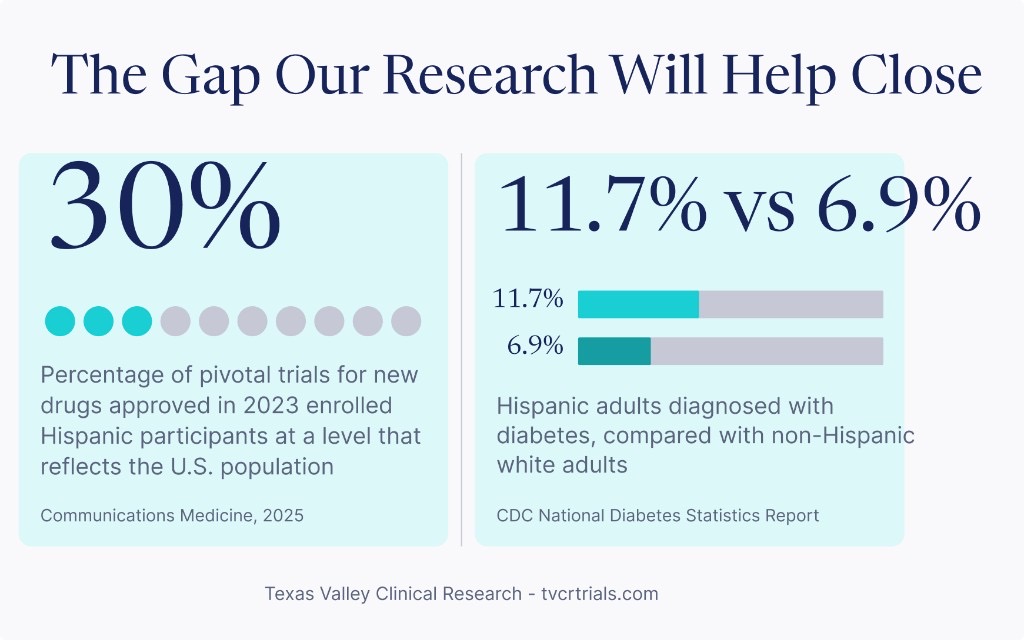
Hispanic Americans make up nearly one in five people in the United States. Yet when researchers looked at the pivotal trials behind every new drug the FDA approved in 2023, fewer than a third of those trials enrolled Hispanic participants at a level that reflected the country's population. That gap has not been closing over the past several years. In some studies, it has widened.
Here in the Valley, that gap has a face. More than 90 percent of our neighbors in Hidalgo County are Hispanic. According to the CDC, Hispanic adults are diagnosed with diabetes at nearly twice the rate of non-Hispanic white adults, 11.7 percent compared with 6.9 percent, and Mexican American adults carry some of the highest rates of any group. Heart disease, obesity, and fatty liver disease follow similar patterns.
So the communities most affected by these conditions are often the least represented in the research that produces their treatments. That is the gap we want to help close.
Why Representation Changes the Answer
It is tempting to think a medicine either works or it doesn't. The truth is more personal than that. Genetics, diet, family history, and everyday life can all affect how a person responds to a treatment, what dose works best, and what side effects show up. When a study enrolls people from the Valley, the results tell us something real about the Valley. When it doesn't, doctors here are left applying findings from somewhere else and hoping they translate.
Representation is how research earns the right to say a treatment is safe and effective for you, your parents, and your children.
What Gets in the Way
We hear the same concerns from families across the Valley, and they are reasonable ones.
Some people have never been asked. Research opportunities have historically clustered in large academic centers far from communities like ours. Some worry about language, and whether they will understand what they are agreeing to. Some carry a healthy skepticism rooted in history, and want to know exactly who is looking out for them. And some simply cannot take a full day off work to drive to a study visit.
Each of those barriers is real. Each of them is also something a clinic can do something about.
How We Try to Do Better
TVCR was built in the Valley, for the Valley. Our clinics in Weslaco and Mission, and now San Antonio, mean study visits happen close to home. Our team is bilingual, and informed consent is a conversation in the language you are most comfortable in, with all the time you need to ask questions. Our coordinators are your neighbors, and many of them have family members living with the very conditions we study.
We also show up where the community already is: Onion Fest, at Alfresco Weslaco, at Camp Freedom, not to recruit but to listen. Those conversations shape which studies we bring here and how we run them.
Participation is always voluntary. You can ask anything, take your time deciding, and leave a study at any point without it affecting your regular medical care. Study-related visits, tests, and medication are provided at no cost, and many studies compensate participants for their time and travel. Those are the basics of respectful research, and they are the least you should expect.
An Invitation
Hispanic Heritage Month is about pride in where we come from. We believe that pride should extend to the future of medicine, too. The treatments the next generation of Valley families will rely on are being tested right now, and they will only be as good for our community as the people who help test them.
If you or someone you love is living with diabetes, heart disease, thyroid disease, or weight-related health concerns, we would be glad to talk with you about whether a study might be a fit. No pressure, no obligation, just an honest conversation about your options.
Because the Valley deserves research that reflects the Valley.
